
Published on The Fabricator, By Lincoln Brunner, November 9, 2026
How one integrated punching, panel bending, and laser welding cell turns days of production into minutes for a Wisconsin metal manufacturer
When a metal fabricator purchases a new machine—a brake, a laser, or a welding cell—talk quickly centers on improvements in overall productivity. What if it boosted output by 20%, maybe even 25%? Wouldn’t that be great?
However, in the case of Robinson Inc. in De Pere, Wis., and its recently commissioned Salvagnini S4/P4 punching and panel bending cell, the vibe hasn’t been about improvement—rather, more like “transformation.”
The fully automated cell—twin material handling towers feeding a combination punch/panel bending machine served by a laser welding station at the back end—represents a multimillion-dollar investment for the rapidly growing contract fabricator (currently No. 5 on this magazine’s FAB 40 list of successful metal fabricating companies).
The punching and panel bending portions of the cell have been running for more than a year, but the final phase, the automated laser welding unit, began operation at the beginning of this summer.
Though it spans a formidable 13,250 sq. ft., it’s not so much the floor space that the cell commands at Robinson’s Plant 1 building. Instead, it’s the number of machines that the cell has displaced and the time per part that the company has saved since installing it.
“You’re talking about running hundreds of sheets a day off of that machine,” Robinson COO Joe Brittnacher said. “That would have taken us multiple days to accomplish [previously] with a lot more labor. What we’re getting from an output standpoint out of every square foot that that machine takes up is far more than what an addition would gain for us.”
Streamlining in the Extreme
Where Plant Manager Shane Steffens and his operators just last year were moving the company’s bread-and-butter electrical enclosures from lasers to press brakes to welding machines, those parts now are processed beginning to end in one place.
One batch of wall panels for enclosures (measuring about 2 by 10 ft.) that were being made during The Fabricator’s recent visit to Robinson illustrated just how seamless the company’s process has become.
It begins with the twin material storage towers, which can each hold 24 bundles of material. Each shelf has a 6,000-lb. capacity, but Robinson’s bundles are 4,000 lbs.
And the company makes the most of that capacity. In one recent 24-hour period (the company runs three shifts, seven days a week), the cell processed four truckloads of 60- by 160-in. sheet—a typical day’s work.
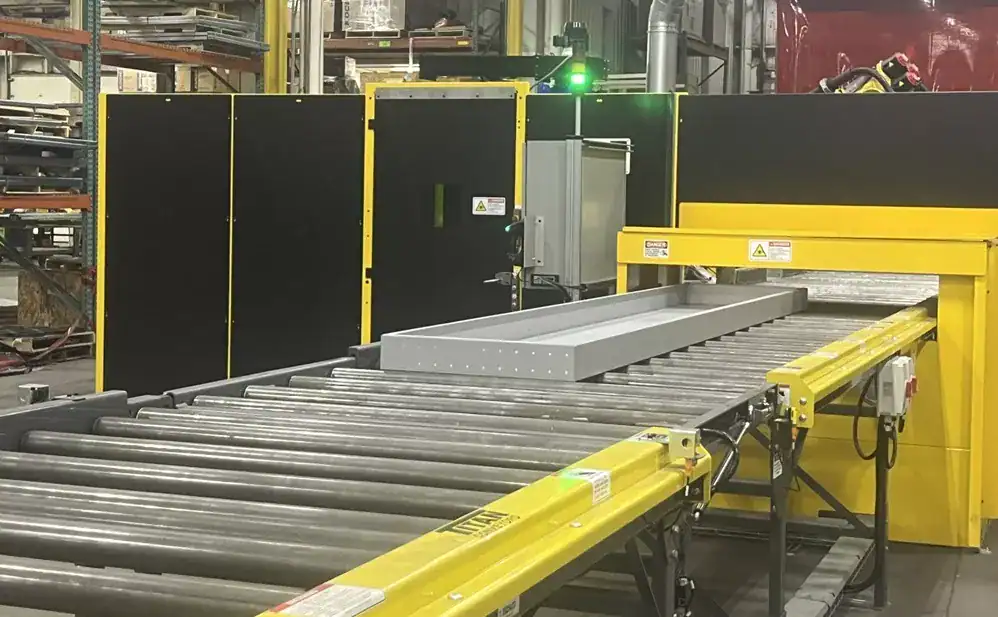
Dozens of welders once worked on wall panels that are now formed and laser-welded in one continuous process.
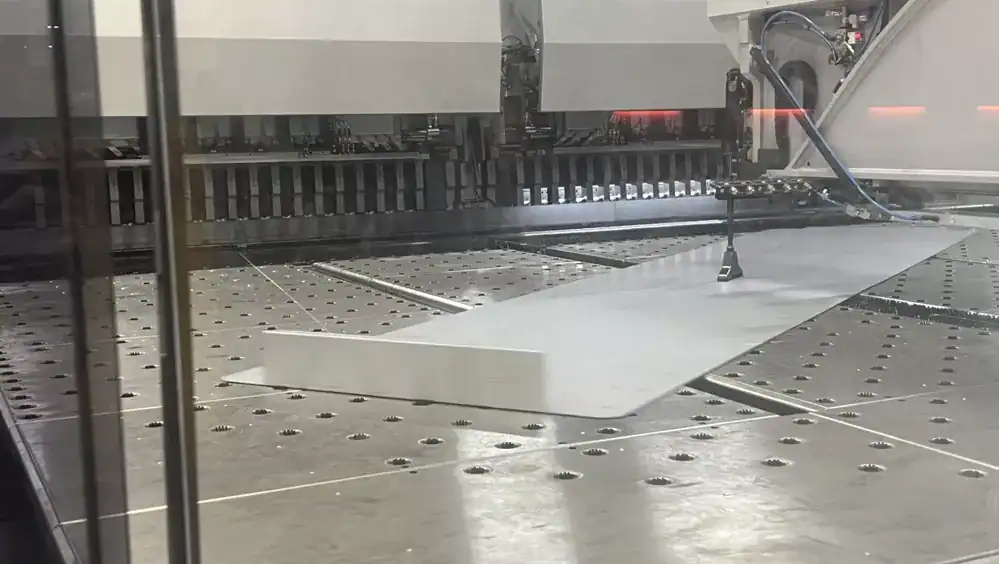
From the towers, a powered roller bed moves a sheet (usually 14-ga. galvanized or galvanneal material) from a shelf to the punching bed, where a sea of brushes supports the sheet while it is punched. From there, the roller bed moves the punched sheet to the panel bender, where a robotic arm, pressing down on the sheet from above, spins and moves the sheet laterally on a smooth steel bed between bends.
The machine then rolls the punched and formed enclosure to the laser welding station, which Robinson worked with a third party to create and install. The finished enclosures are then stacked automatically on a skid, where they await powder coating and any other needed secondary operations.
That entire process takes three minutes.
“I think the big one is time,” Brittnacher said of the cell’s impact on the shop’s work-in-progress. “The processing time on a part—we’re talking minutes. It adds up quick.
“What it used to take Shane to cut it, move it to a press brake, move it to a weld station, and then move it to its staging area to leave—that was days. Now we can get those same parts done in the morning from start to finish and into that staging area.”
Rather than minutes or hours, Steffens quantified the process in touches—the number of times his operators have to touch a part before it’s done. If you want to measure the delta before and after the panel bender, that’s a good number to watch.
“No matter what we do, we have to load material—but after that, we were up to nine or 10 touches before the part was fully welded,” Steffens explained. “Now, we’re at one touch. We load material, and it’s a fully finished product by the time it’s at the end. So, you eliminate 10 or 11 touches on that particular part.”
One small note about material usage: Because sheets are delivered at precisely the size the company requires, the process produces very little scrap—no skeletons to be found. A small bin located between the material handling towers and the punching station holds a variety of pieces, most measuring around 2 by 12 in. with just a few larger pieces measuring about 6 by 8 in.
“There’s nothing to remove, nothing to shake,” Brittnacher said. “Everything ends up here, and the only thing that goes through are parts.”
Repurposing Space and Talent
What all this has done to the company’s physical space and workforce is nothing short of remarkable.
In one corner of Plant 1, the cell has completely emptied an entire bay of welding machines—and the 40 welders who worked there across two shifts, every day. All the welding, grinding, and polishing those people once did, on parts once fabricated on lasers and press brakes, is now negated by a laser welding machine that doesn’t require finishing work. That space and those labor resources are now being used to capitalize on new business opportunities without the need for investment.
As for all those welders, Brittnacher said they’re being put to work welding parts for new areas of business and existing jobs that the new multiprocess line can’t do. At the same time, it helps the company make better use of its brakes for other parts because it can consolidate the work not destined for the new cell.
“We can group up all the similar parts and put them on a press brake and let them run” Brittnacher explained. “What we’re working on right now is [something like this]: Press Brake 21 is going to get only these parts now, and Press Brake 16 is only going to get these parts. And then we can use that to work on continuous improvement within those groups of parts that we couldn’t otherwise do because they were kind of being moved around to where the holes were.”
Power Gen and Unprecedented Demands
The large capital expenditure is an attempt to keep up with the explosion in demand from the power generation industry, which represents a large portion of Robinson’s business. Demand for generators, of course, is in turn being driven by a data center blitzkrieg. Power consumption in the U.S. by data centers alone is projected to increase from 31 gigawatts in 2025 to 66 gigawatts—enough to power 49 million homes—next year, according to a recent Goldman Sachs report.
That runaway growth is running downhill quickly to Robinson, which projects 40% growth this year, followed by the same in 2027 and 2028.
To keep up with that demand and get while the getting is good, the company has built a 623,000-sq.-ft. greenfield facility in Altoona, Iowa, that is set to begin operation on Jan. 22. The company is interviewing and training people right now to work in that shop, which will employ about 200 people. That’s in addition to the nearly 1,100 working at its facilities in De Pere and Manitowoc, Wis.—a number the company doesn’t expect to decrease anytime soon as it keeps pace with orders that have it booked out until 2030.
“It just keeps coming,” Brittnacher said of the growth in demand for enclosures. “It’s the generators, but there’s a lot of stuff that people need to put in metal boxes for other components of these data centers. So, we say ‘no’ sometimes more than we say ‘yes,’ but we’re trying to be very strategic with where we can grow.
“We’re looking out with customers sometimes four or five years in advance to provide targets for what we can commit to them because that’s what they need from us. A lot of this automation that we’re doing is trying to get ahead of that, so that when demand comes, we’re prepared for it. That’s what led to the Iowa facility.”
Adjusting to the New Normal
Adding the new multiprocess cell hasn’t just changed lead times on enclosures—it has completely altered the physical space and staff demands at Robinson’s Plant No. 1.
For starters, the machine requires only one operator at a time. Robinson officials report that employees are able to get up to speed on the new equipment much more quickly than if they were training to run a press brake. Robinson selected its most highly skilled machine operator and sent him to Salvagnini for training. That person works hand in hand with the shop’s programming team to work out the kinks and figure out a smooth workflow.
“The biggest thing is to ask questions. What does he see to make the machine move better, move faster, save on tooling?” Steffens said.
The company wants to have six operators who can run the cell and also expand training to all of its operators who currently run press brakes. Right now, among others, the company’s training a welder, an operator who’s familiar with punch presses, and another with press brake experience to run the cell.
Looking ahead, Brittnacher said Robinson has two goals. First, as the company becomes more familiar with the machine, it wants to transition the role from one requiring highly skilled employees to a standard machine operator position. Second, it plans to establish a technology support team to assist employees who operate and maintain the modern equipment coming online, including a new automatic beveler, robotic welding machines, and other machinery.
“We’ve actually had to take a step back and think about all the aftermarket support, as well,” Brittnacher said. “Once this equipment is installed, we can’t expect Shane’s team to be robotic gurus. We’re actually having to add another layer in there as we build, because it’s not just the Salvagnini.
“I’ve seen companies make a mistake. They get all this automation technology and then they don’t what to do with it. You’ve got to have that layer [of support]. Otherwise, you’re totally relying on the OEMs or the machine designer, and then you’re at the mercy of their technicians for a lot of this stuff. Their charges are not cheap.
“So, we’re working on building that team. If there is an issue, we’ve got in-house resources that can jump on it and get it back up and running quickly without having to rely on outside parties.”
As the company continues its growth initiative, it wants to remain a vendor of choice for top-tier power generation clients, which are in turn working around the clock to serve their customers in the push for all things AI. Investing in the new equipment was a key component of that initiative.
“If we can’t do it, they’ve got to find someone,” Brittnacher said. “So, we’re trying to be more of that provider for them.
“We couldn’t keep doing it the old way with a laser, a brake, and a person actually welding,” he added. “We had to go fully automated. That’s the only way we’re going to be able to grow as fast as our customers need us to.”